
TRAMPLE OR CUT TRACKS?
Two approaches as starting points for addressing the messes we are in

Some time ago, I came across a post* about Molinia (moor grass) infestations which drain the life out of a landscape, and the author mentioned: ‘It’s true that one possible way of suppressing Molinia is by running cattle on it over the course of one winter, so that their trampling breaks up the sward.’
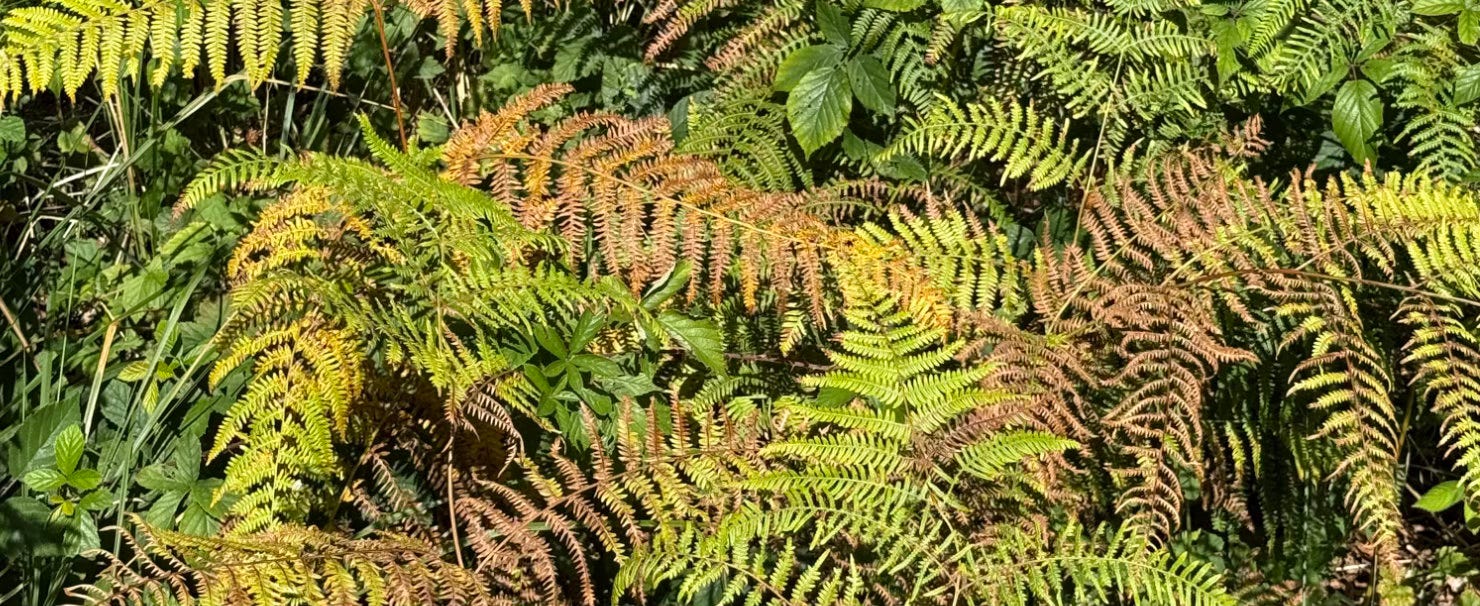
Some time later, I read an article** about a temperate rainforest where bracken (fern) keeps other plants from thriving, and the interviewee said: ‘I noticed that, where I cut access paths through the bracken, wild self-seeded trees quickly took advantage and corridors of saplings began to spring up (…) once trees grow beyond the chest-high bracken tops, they’re able to carry on by themselves, and will ultimately shade the fern out, returning it to its natural niche as just another component of the ecosystem.’
And I thought, wow, here are two valid approaches, trample or cut a track, which we can explore for our own efforts to reshape a world that works for people and planet.
The moor grasses and ferns of our world are obviously oligarchs, autocrats, warmongers, populists, supremacists and much of the media, but I’d also include the economic and political systems, and quite frankly many of the narratives that inform our societies and could do with a thorough rethink.
All of the above throttle the planet’s and humanity’s ability to thrive. We are overdue rising and shaping a world that makes sense, recovers, and discovers everything that is possible if we don’t accept anything that destroys.
So, what can trampling and cutting track look like for our efforts to restore and reshape our world?
__
//
TRAMPLE
Let’s start with trampling. I’m personally not a big fan of trampling, but since our planet’s and our communities’ situations are getting worse by the day, we should make some use of it.
What is an equivalent to herds of cows trampling across lands infested by Molinia?
__
//1
Questioning
Question the status quo. This might sound tame. But I know from experience that once you start to think, it can get very wobbly, and former certainties are revealed as nothing but another moor grass infestation.
Fair warning: once you start thinking, you can’t unthink. And yes, change starts in the mind. Molinia has been feasting in far too many minds and the best trampling tactics in those cases are: asking questions, thinking, stepping out of the box, leaving the known bubbles, challenging perceptions.
__
//2
Change the rules
There is an easy and fast way to end all fossil fuel extraction. Declare that no natural resource can be sold for profit. The moment no one can make money with crude oil, there’s no incentive to extract fossil fuel, and we can dismantle the energy giants.
What do we need upfront?
A simulation which
a) documents where which amount of energy is needed,
b) suggests ways to reduce demand,
c) creates a map of where to best generate which amounts of energy so that every corner of the planet has what it needs and what the planet can stomach.
__
//3
Expose
Expose the players, practices, partnerships, pollutions, profits who/that cause harm. Relentlessly. Inescapably. Constantly. And have a particular eye on all the nonsense that has been normalised or that some refer to as the new normal. Let’s expose nonsense. Let’s refuse to call abnormalities normal. Or dysfunctional functional.
__
//4
Boycott
Boycotts are incredibly powerful — if enough people participate.
In fact, boycotts are one of the greatest powers we have.
The big question is, what does it take so that hundreds of millions of customers say: I don’t buy anything wrapped in plastic. I don’t use fossil fuels. I don’t have anything to do with companies like Amazon. I don’t use What’s App, Instagram or Google because the owners of those companies support Trump, exploit, and so on.
And the answer is: I don’t know. But boycott is too great a tool to dismiss it. And I encourage everyone to try and find hooks which get more people on board with boycotts.
__
//5
Attack
We still have some laws we can use to attack. Like with boycott, the more people get involved the more powerful this kind of trampling is. What if, for example, groups of people from different countries got together and launched similar lawsuits against polluting and/or exploiting corporations and do so in concert? There’s a lot of potential when we don’t restrict our actions to a single region, case or country, but if we, too, understand that everything is connected, and that our chances are best if and when we make the world our concern.
__
//6
Demonstrate
Be loud. Trample through the streets. Make yourself seen and heard. Again the more the better. The clearer the messages the better. And also again, the more marches globally at the same time the better.
And here is another thought.
A demonstration can point to anger, opposition, and demand change. It can also be an actual demonstration of a) what is at stake? And b) what are the alternatives?
__
//7
Disobey
You are not OK with how the world is run? Then don’t play along. You are not OK with a task given to you? Then don’t play along. You are not OK with an order given to you? Then don’t play along.
__
//8
STRIKE
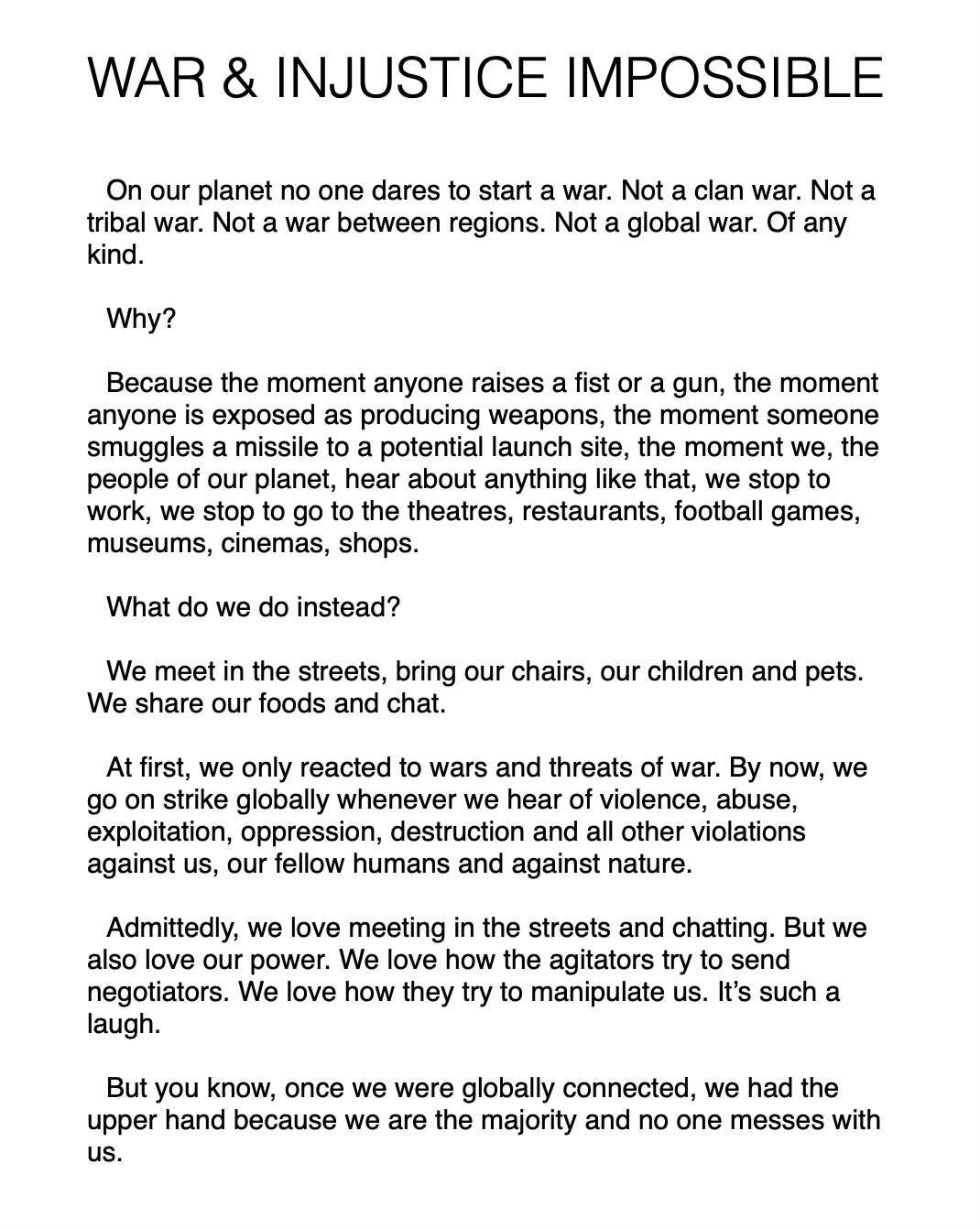
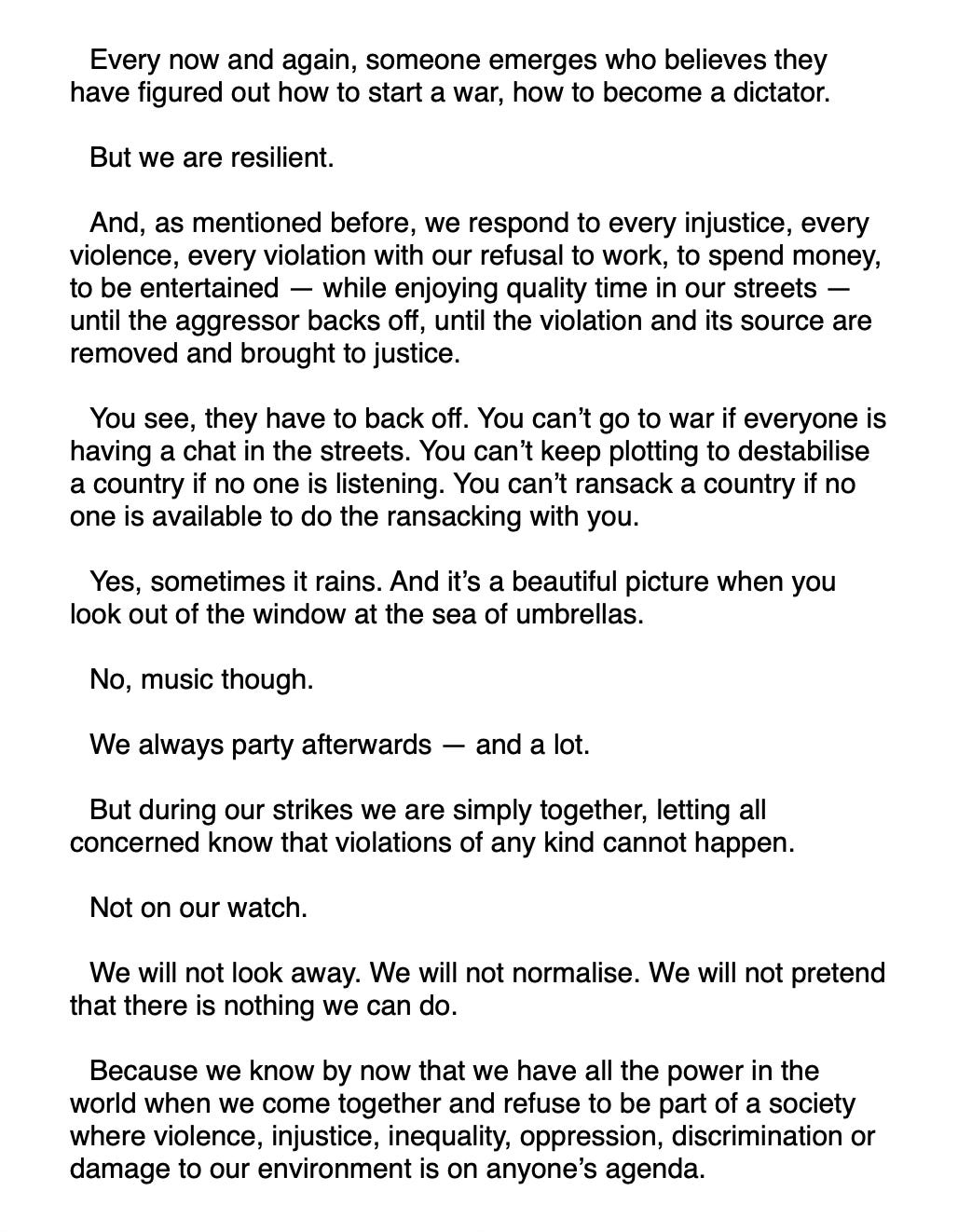
My favourite idea is that of a general strike which I used in a MAKE IT HAPPEN STORY, in May 2025.
The story speaks for itself and is applicable to everything we can and should oppose.
The moment we refuse to play along with the political and economical systems which fail us day after day, is the moment where we can start over and reshape our world.
__
Trampling needs herds of cows. A single calf will have no effect. A single herd will hardly be noticed.
But how do we get 8 billion people to trample?
Quick reminder: There’s only some million people screwing with our planet, with our communities and with us. The rest of us can wake up, stand up and get to work: rethinking and reshaping our world.
__
//
The catch with trampling
As the author* points out ‘But unless this is a deliberate step towards the restoration of either rainforest or blanket bog, it (trampling) will solve nothing.’
In other words, we need to consider what we want to replace the moor grasses and ferns of this world with. The better our ideas, visions, plans and preparations the easier the transition will be. Plus, once we begin to communicate comprehensible plans, more people are likely to join the efforts of reviving and restoring our planet and our communities.
Some trampling will be needed on our way to reshaping our world.
However, we can use a good deal of our energy to carve out tracks and initiate cracks in the carpets of deadly bracken.
__
//
CUT A TRACK
What could cutting a track look like for our world? What are our options?
Finding seeds & saplings, carving out tracks to give them room to breathe and grow unhindered, watering, taking care that the tracks stay open, encouraging, empowering, collaborating, creating, building, celebrating.
Nice words. I know. But what can any of this look like in practice?
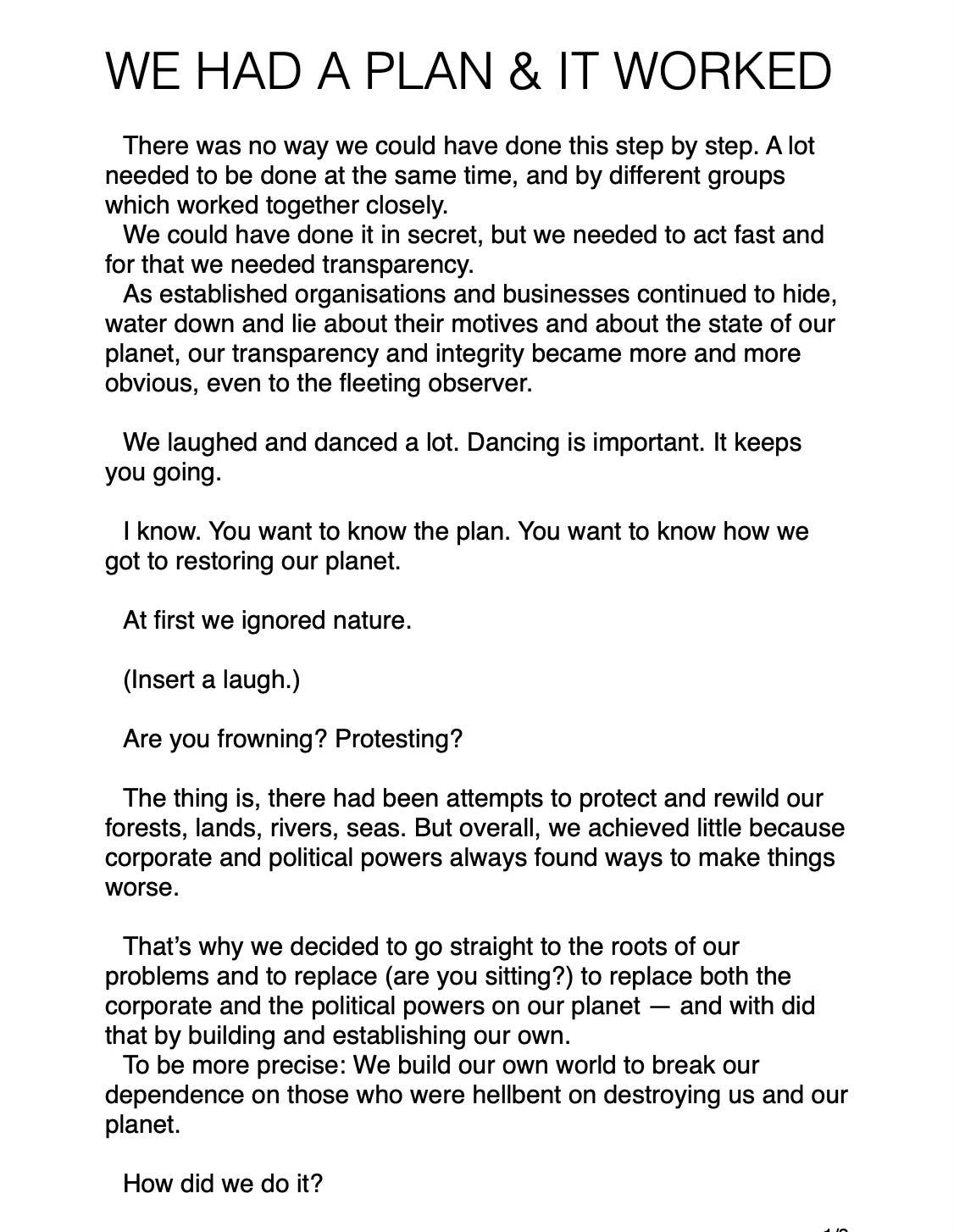
In summer 2025, I wrote another MAKE IT HAPPEN STORY: We had a plan & it worked. Without knowing it, I did some track carving there.
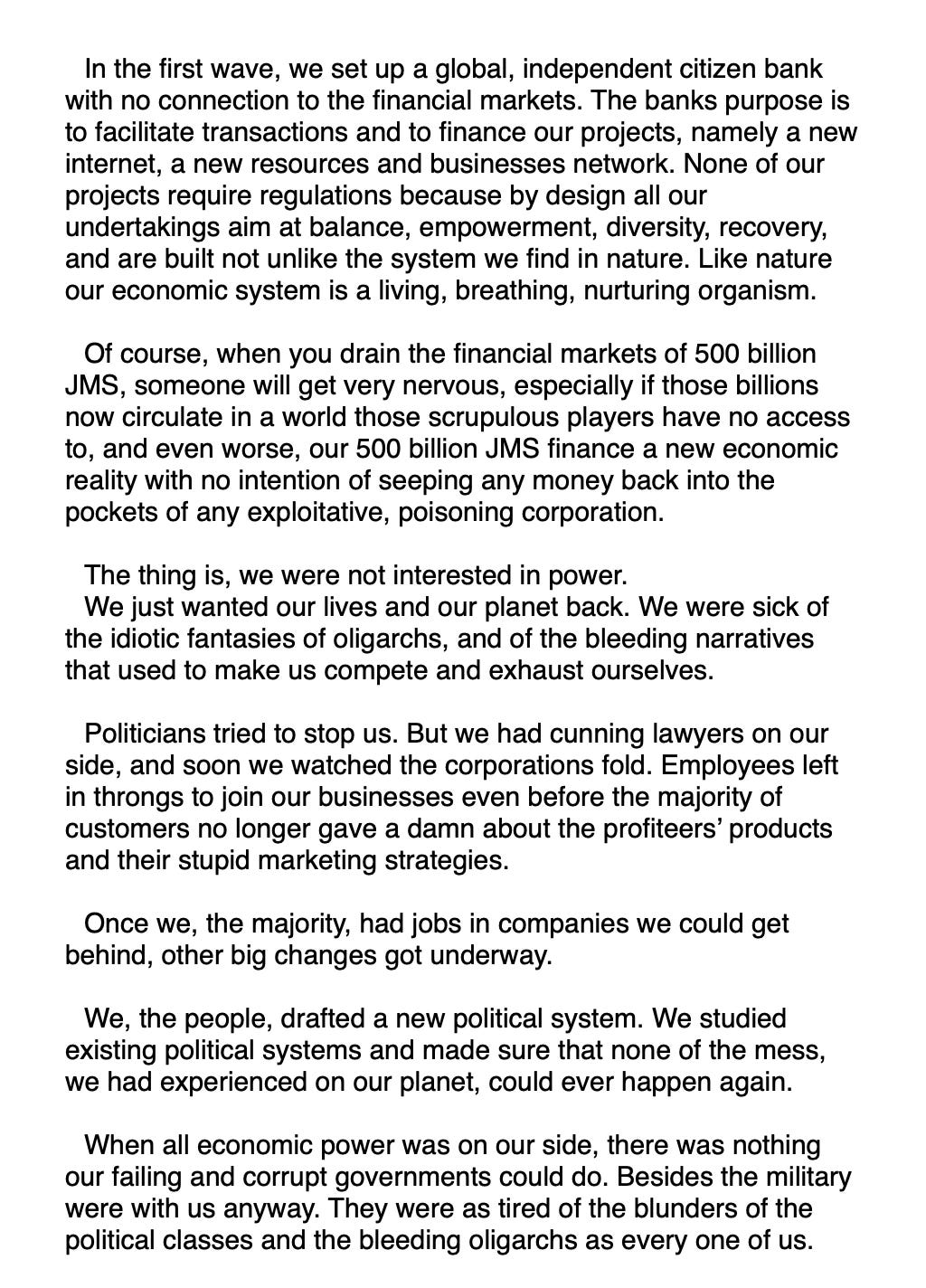
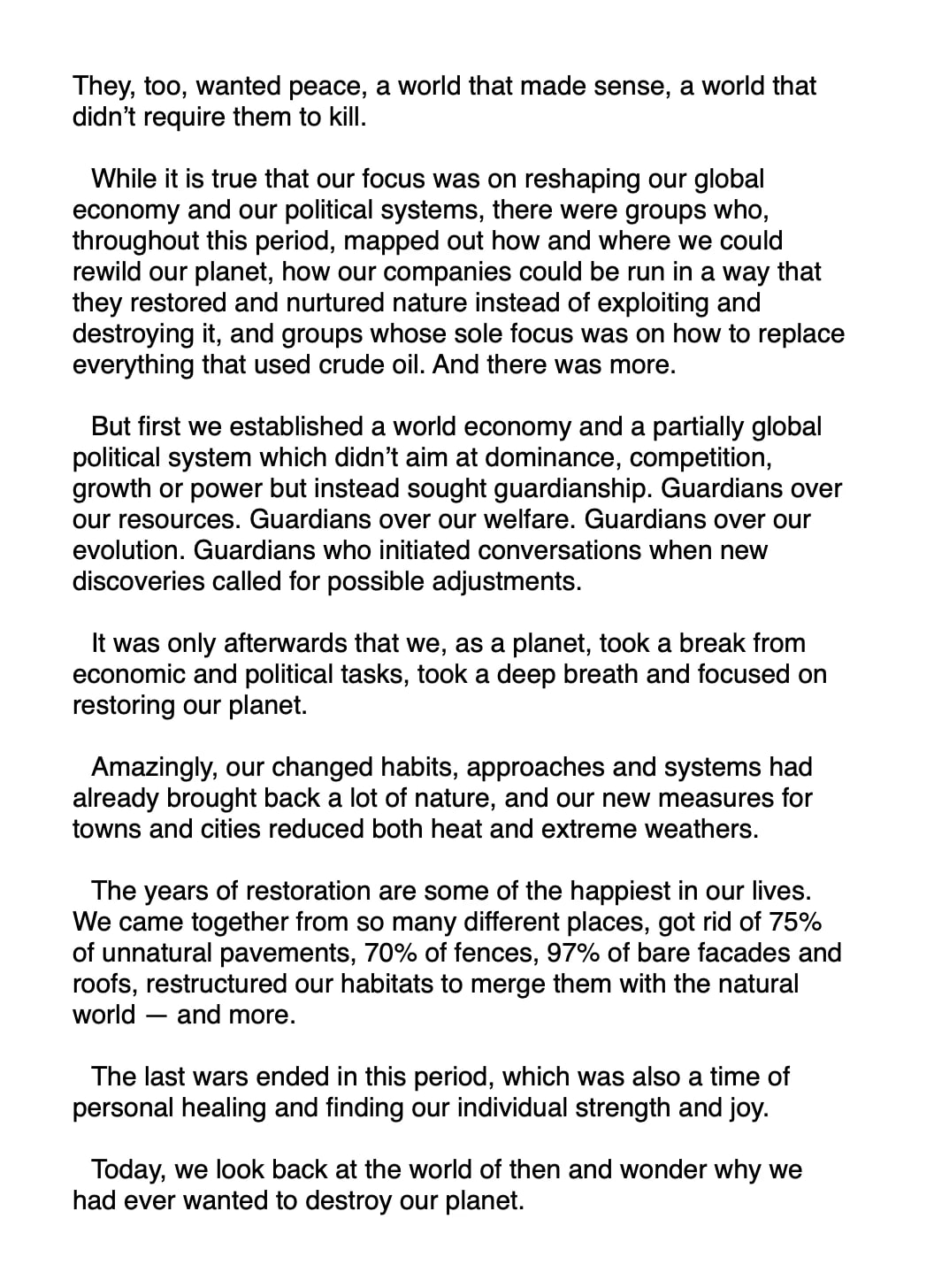
So what exactly did I do in the story?
I decided not to attack, not to trample, not to expose but to walk right into the bracken covered field, clear a track, a bit of space, and create something that has the potential to take up that space, to replace what is and with that to push back the damaging players without once attacking them directly.
How can this be done?
The safest way to plan any such transformations is to build a simulation which highlights where what is needed, where what can be sourced, where what needs to be restored. The aim of such a simulation would be to find out how to build a breathing, living system that is about rewilding our world, celebrating all we are capable of, empowering each other, and doing business in ways that serve all of us and that have the highest respect for creators and for what the individual actually needs (which is a lot less than we are made to believe).
By focusing on building an alternative, we take air and living space from the deadly monocultures and destructions that corporations and autocrats impose on us, and we force them back into the niche where they, too, might find some new life.
The sooner we have our businesses the sooner more people can stop working for those who only know profit and exploitation. Without people to serve them, neither corrupt politicians nor oligarchs have any power.
__
//
There is another catch.
We don’t have decades to slowly carve out tracks, watch, take care, watch again. Quite the contrary. The faster we act the better.
How?
__
//Step 1
Realise that there is nothing human-made that can’t be changed.
__
//Step 2
Join in the rethinking and reshaping processes.
__
//Step 3
Pick a project you want to support or you want to become part of.
__
//Step 4
Let’s set up a project bank, let’s programme our own internet, let’s set up the first two or three new businesses and the related supply networks, and from there let’s add one business after the other, covering everything from foods to tech, from clothes to books, and with that create a world that has finally shaken off the damaging narratives of competition, profiteering and exploitation of people and planet.
__
Let’s do this, trampling and cutting tracks alike. And lets be so excellent that more and more people will want to be part of whatever we think up next. Let’s overwhelm with positive vibes and visions. Let’s pop up everywhere.
It’s time to shout from every roof: Enough is enough! We are tired of the idiocies of a few. We will come together and build a world where we restore our planet and our communities, and where we are curious about the myriads of worlds and talents which are in us.
I’m certain that we can carve out tracks which weaken present players if we, the people, act globally.
__
References
* George Monbiot,
** Eoghan Daltun